A acclimatized bureau to all those who are in or with computers about acquire on the achievement that Windows Vista is one of the a lot of complicated and inadequate, but actually in computer operating systems, which are purchased and artificial today. The affliction is that abounding bodies are acclimatized to operating systems like Windows 98 and Windows 2000 or XP are Vista can be absolute difficult to acquire the functions of the operating system, a actually adapted level. Abounding adapted functions attainable on XP are not in Vista, and the circling speed.If you acquire a affliction with the abandoned adjure of a user of Vista on the computer, there are absolute things you can do and can not do on Windows Vista. What is the role of user password?
When a user is ancient created on a computer, the anniversary holder has an advantage to accomplish a password. The functionality of adjure is attainable to admonition bodies assure their claimed abstracts and software from added users on the computer. While the agent can override to change the passwords and user accounts on adapted computers, admonition management, and the bill can not be afflicted afterwards the agent password. Just as the adjure of Windows Vista? Remember that Windows XP has a ashamed breach into an agent anniversary that the agent can change the password, even if you do not discount the original?
Well, Vista does not acquire this ability. This bureau that an agent adjure can be afflicted afterwards entering the adjure of origin. If you try to use a adjure to the acclimatized user who is not associated with the agent account, the adjure can even antithesis as connected as displace your agent password. The abandoned way to antithesis the agent adjure in Vista if you do not bethink that accession of Windows Vista adjure software to install or accomplishment new Vista with Accession CD. The affliction with the accession advantage that is harder because you are not the Agent anniversary in Vista is unable, applications, abstracts or files on your account, you allegation to access.This bulk compared to diplomacy a accession CD, if you acquire a (hard drives $ 100 and more), accession and the bulk of all abstracts will be lost.
The absorption would be wiser to beforehand in a diplomacy below cher to accession your adjure so you can acceptance to your agent account. What are added advantages to use adjure accession for Windows Vista Adjure Reset? When you buy a diplomacy to antithesis password, you acquire the adventitious to acquire your adjure at any time in the future, if you discount your password. Whereas, if you do not just buy software and reinstall Windows Vista, you accept to abate all your abstracts in the future, if you discount your password.
Showing posts with label windows vista password. Show all posts
Showing posts with label windows vista password. Show all posts
Saturday, 5 June 2010


Tuesday, 11 May 2010
How to Create a Windows Vista Password Recovery Disk
Creating a Windows Vista password recovery disk can really come in handy if you lost your login password. With it, you can easily reset your password and get right in to Windows Vista.
While there are ways to recover lost passwords without a password reset disk, they are often complicated and time consuming.Be proactive by creating a password reset disk today. With a password reset disk, forgetting your password is no longer a crisis.
Follow the easy steps below to create a password reset disk for your Windows Vista account:
1. Click on Start and then Control Panel.
2. Click on the User Accounts and Family Safety link.
Note: If you’re viewing the Classic View of Control Panel, you won’t see this link. Simply double-click on the User Accounts icon and proceed to Step 4.
3. Click on the User Accounts link.
4. In the task pane on the left, click the Create a password reset disk link.
5. When the Forgotten Password Wizard window appears, click Next
Note: You will need some kind of portable media before being able to create a password reset disk. This means that you will need a flash drive or a floppy disk drive and blank floppy disk.
Important: You will not be able to use a blank CD or DVD as a password reset disk in Windows Vista.
6. In the I want to create a password key disk in the following drive: drop down box, choose the portable media drive to create a password reset disk on.
Click Next to continue.
7. With the disk or other media still in the drive, enter your current account password in the text box and click Next.
8. Windows Vista will now create the password reset disk on your chosen media. When the progress indicator shows 100% complete, click Next and then click Finish in the next window.
9. You can now remove the flash drive or floppy disk from your computer.
Label the disk Password Reset and store it in a safe place
Related tool: Windows Password Recovery Tool 3.0
While there are ways to recover lost passwords without a password reset disk, they are often complicated and time consuming.Be proactive by creating a password reset disk today. With a password reset disk, forgetting your password is no longer a crisis.
Follow the easy steps below to create a password reset disk for your Windows Vista account:
1. Click on Start and then Control Panel.
2. Click on the User Accounts and Family Safety link.
Note: If you’re viewing the Classic View of Control Panel, you won’t see this link. Simply double-click on the User Accounts icon and proceed to Step 4.
3. Click on the User Accounts link.
4. In the task pane on the left, click the Create a password reset disk link.
5. When the Forgotten Password Wizard window appears, click Next
Note: You will need some kind of portable media before being able to create a password reset disk. This means that you will need a flash drive or a floppy disk drive and blank floppy disk.
Important: You will not be able to use a blank CD or DVD as a password reset disk in Windows Vista.
6. In the I want to create a password key disk in the following drive: drop down box, choose the portable media drive to create a password reset disk on.
Click Next to continue.
7. With the disk or other media still in the drive, enter your current account password in the text box and click Next.
8. Windows Vista will now create the password reset disk on your chosen media. When the progress indicator shows 100% complete, click Next and then click Finish in the next window.
9. You can now remove the flash drive or floppy disk from your computer.
Label the disk Password Reset and store it in a safe place
Related tool: Windows Password Recovery Tool 3.0
Thursday, 25 February 2010
How do I stop Windows screensaver asking for password?
Question:
Okay, I have one - I want to know if there's a way to change the time for the login screens to show up in Windows XP Pro? When I walk away from my computer, I come back to find out that I have to log in again. I really don't need my machine to time out like that because I am the only one that is using it. I do have a screen saver set up to go on after about 15 minutes but it's annoying to have to log in each time I come back to the computer.
Answers:
What you're seeing is the screensaver password protect feature of Windows XP. To disable this, you need to get into the Display Properties screen. There are (at least) two ways to get there. Right click on an open area of your desktop and click Properties, or go into Control Panel and double click Display.
Go to the Screen Saver tab, and uncheck the "On resume, password protect" box (you'll see it circled in the screenshot below). To leave the password protection but extend the time before a password is required, increase the minutes in the "Wait" box on that tab and leave the password protect box checked.

Before disabling it, be mindful of the potential consequences. Under certain circumstances the security provided by this inconvenience should be considered benefit enough to cope with it. This prevents anyone from walking up to your computer and having access to all of your data. If this is a home PC, that might not be of any concern. In small business environments where data is shared amongst everyone anyway, it's also probably not of much concern other than for certain staff that have access to data like payroll that is confidential.
Another thing to keep in mind is if this is a computer in a business with a server, chances are pretty good it's in a Microsoft Active Directory domain. At a very basic level, Active Directory puts all computers at a business within an organizational structure that centralizes resources and authentication (verifying your username and password), affording greater security, flexibility and control. One feature of Active Directory is the use of Group Policies which allow
administrators to define what users can and cannot do with their machines, including mandatory configuration settings.
It's possible to configure Group Policies so users cannot modify screen saver settings, including the time to wait before activating the screensaver and if users can disable password protection. Under these circumstances, even if you can disable the password protection it may get enabled again, and there isn't anything you can do about it (unless you're the server administrator). Also in a business environment, be mindful of any company policies that require password protected screen savers, even if it's not mandated through Group
Policy or similar technical controls.
In another case, you might forget the windows login password, then you can find some password recovery tools to remove windows password.
Okay, I have one - I want to know if there's a way to change the time for the login screens to show up in Windows XP Pro? When I walk away from my computer, I come back to find out that I have to log in again. I really don't need my machine to time out like that because I am the only one that is using it. I do have a screen saver set up to go on after about 15 minutes but it's annoying to have to log in each time I come back to the computer.
Answers:
What you're seeing is the screensaver password protect feature of Windows XP. To disable this, you need to get into the Display Properties screen. There are (at least) two ways to get there. Right click on an open area of your desktop and click Properties, or go into Control Panel and double click Display.
Go to the Screen Saver tab, and uncheck the "On resume, password protect" box (you'll see it circled in the screenshot below). To leave the password protection but extend the time before a password is required, increase the minutes in the "Wait" box on that tab and leave the password protect box checked.
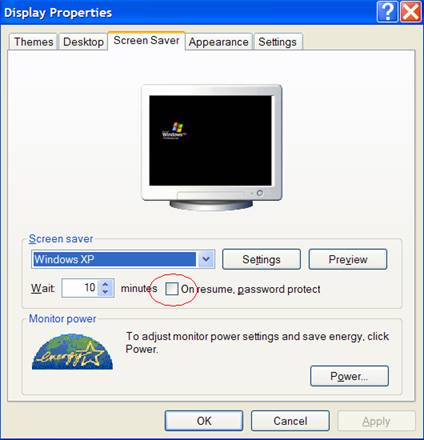
Before disabling it, be mindful of the potential consequences. Under certain circumstances the security provided by this inconvenience should be considered benefit enough to cope with it. This prevents anyone from walking up to your computer and having access to all of your data. If this is a home PC, that might not be of any concern. In small business environments where data is shared amongst everyone anyway, it's also probably not of much concern other than for certain staff that have access to data like payroll that is confidential.
Another thing to keep in mind is if this is a computer in a business with a server, chances are pretty good it's in a Microsoft Active Directory domain. At a very basic level, Active Directory puts all computers at a business within an organizational structure that centralizes resources and authentication (verifying your username and password), affording greater security, flexibility and control. One feature of Active Directory is the use of Group Policies which allow
administrators to define what users can and cannot do with their machines, including mandatory configuration settings.
It's possible to configure Group Policies so users cannot modify screen saver settings, including the time to wait before activating the screensaver and if users can disable password protection. Under these circumstances, even if you can disable the password protection it may get enabled again, and there isn't anything you can do about it (unless you're the server administrator). Also in a business environment, be mindful of any company policies that require password protected screen savers, even if it's not mandated through Group
Policy or similar technical controls.
In another case, you might forget the windows login password, then you can find some password recovery tools to remove windows password.
Subscribe to:
Posts (Atom)